
You’re an independent voice on program risk – but your sources of information are not.
Let 20 years of project data provide your third line of defence against program failure.
The typical response is to commission Big-4 assurance. It is credible, thorough, and runs $50,000 to $80,000 per engagement with a four-to-eight-week lead time. At that cost and cadence, it cannot be sustained at every stage gate across every material program. You commission it selectively on the highest-profile investments. The rest pass through with PMO reporting — which is internally generated, not independent, and does not meet the third-line standard the committee expects.
Generic maturity frameworks do not close the gap either. They measure process adherence — whether templates exist, whether governance meetings are held — not control adequacy or business readiness. They do not produce a decision-grade output the committee can act on. The committee receives a process compliance assessment when what it needs is an independent answer to a specific question: should we release the next tranche?


Your instrument, your audit plan, your findings
ProjectPhD is a specialist stage-gate diagnostic designed to be commissioned by Internal Audit as a recognised control within the annual audit plan. It sits alongside financial audits and compliance reviews — not as a replacement for audit, but as a specialist instrument for a domain that requires specialist assessment. You do not need to become a delivery assurance specialist – you commission a specialist instrument and apply your audit judgement to the findings.
Within 72 hours, you receive an Assurance Report that benchmarks the program against a matched peer cohort — programs of comparable size, sector, category, and complexity — and produces conditions-to-proceed with a decision-grade recommendation: proceed, step-up discipline, or commission full assurance. You can cite it in audit findings as an independent evidence-based framework — not your team’s assessment, not a personal opinion, but an independently scored diagnostic with transparent methodology. When the committee asks how the finding was derived, the answer is documented.
The evidence base is corroborated through multi-respondent attestation across roles, with the Alignment Index surfacing where stakeholder views diverge. Independence guardrails are published and standing, standardised scoring is not adjusted to client expectations, there are no contingent fees, and conflicts are disclosed. These controls are designed to withstand the independence scrutiny that Internal Audit applies to any instrument it recommends.
Where a stronger evidence base is required, you can upload documents for artefact assessment with redaction, retention controls, and data residency options.

When the diagnostic recommends full assurance and panel restrictions apply, the Panel-RFP Pack provides the mechanism to provide a standard controlled scope document specifying methodology requirements, named-resourcing criteria, deliverable standards, and evaluation criteria — issued to up to three panel providers. This gives you control over assurance quality under panel rules, regardless of which provider wins the engagement. No other instrument occupies this position. ProjectPhD will not recommend a full review unless it is warranted, with justifying reasons provided within the report.
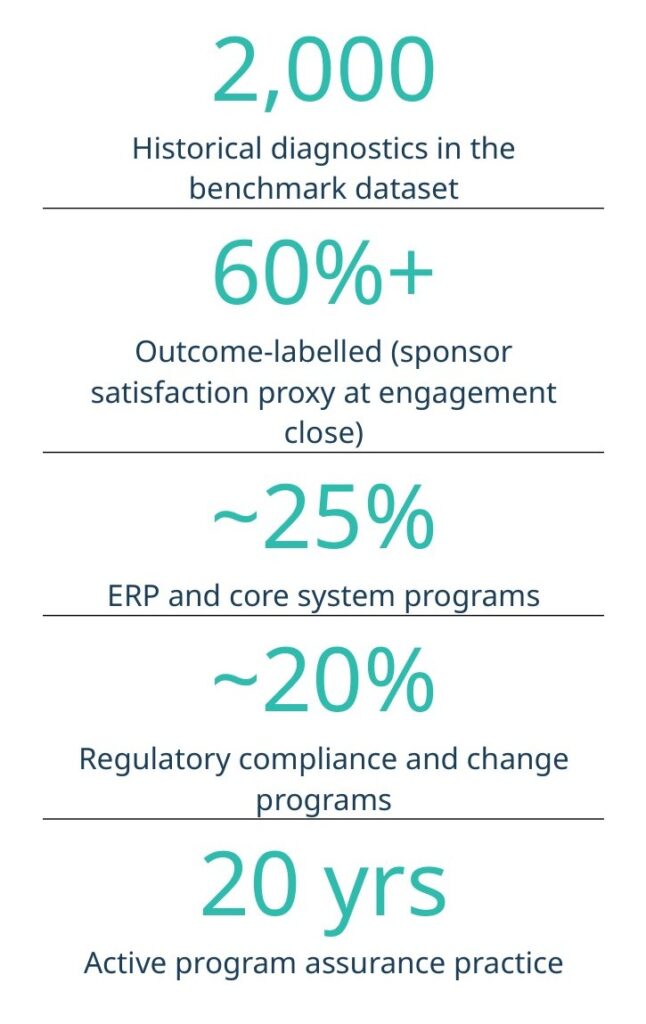
20-Year Empirical Record
The benchmark dataset draws on 2,000+ diagnostics conducted over 20 years of program assurance practice, with roughly a quarter in ERP and core systems and a fifth in regulatory change. Outcome data from 1,200 programs is coded against whether sponsors judged the program delivered to expectations and achieved its intended business outcomes. Statistical regression is applied to calculate correlations and confidence levels. Where cohort matching is thin, confidence intervals are widened and disclosed. Every recommended condition is drawn from the ProjectPhD Recommendations Library — interventions grounded in what governance forums actually needed at the funding gate across comparable programs.
The diagnostic explicitly assesses business readiness and adoption risk alongside delivery controls — recognising that programs which complete their technical deliverables, but where the organisation is not prepared to adopt the outcome, represent a systemic failure pattern that output-tracking frameworks miss. The methodology does not stretch beyond what the evidence supports. It is your documented due diligence.