
When projects still engage in watermelon reporting, when everything is green on the outside, red on the inside – how do you consistently identify and address portfolio delivery risk?
A portfolio level subscription to our project health review tool lets you present consistent, independent verification of every project at every milestone.
Why internal governance falls short
Delivery teams self-assess. RAG ratings are subjective and politically managed. You lack authority to overrule an optimistic green — and when you escalate concerns, the signal is frequently dismissed as bureaucratic overhead rather than a governance warning. Comparability across programs is impossible when every project manager interprets templates differently and reports in a different framework.

Standardised, repeatable diagnostic
The diagnostic applies one methodology at every gate. Multiple stakeholders respond independently, each attesting their inputs. The Alignment Index surfaces where views diverge without attributing to a role or individual — where the project manager reports green and other stakeholders see exposure, that divergence is documented as an overall divergence level, before it becomes a governance failure you should have caught.
What you get at every gate:
- A risk rating with confidence basis, benchmarked against outcome data from 2,000+ comparable programs
- Conditions-to-proceed with owner roles and acceptance criteria — evidence-based, drawn from the Recommendations Library
- A 90-day action plan identifying highest-lift interventions
- A Governance Decision Memo formatted for board circulation
72 hours replaces weeks of manual assembly. The quality is consistent. The outputs are comparable across programs. And a formal Re-Check at 90 days closes the loop on conditions, to provide a built-in follow-through, rather than a filing exercise.
Portfolio governance
A Portfolio Subscription extends the diagnostic across all material programs: consistent, comparable data you present as heatmaps, trends, and watchlist analysis.
This changes your operational position. Instead of assembling PM-submitted artefacts and defending their accuracy, you present independent, benchmarked data to the board. The function shifts from governance assembly to governance intelligence — you become the source of board-level insight, not the aggregator of information senior leadership has already learned to question.
Where individual programs require deeper assurance, the Assurance Panel RFP Pack structures scope, methodology, and resourcing requirements for panel providers. You control assurance quality across the portfolio, even under panel procurement constraints.
From retrospective reporting to forward looking outcome assurance
Most stage-gate processes measure whether milestones were hit in the last period. They do not assess whether the program is set up to deliver the next milestone, or the outcome the business case promised at the end of the project. Business readiness gaps, adoption risk, sponsorship quality, and resourcing adequacy sit outside milestone tracking — and they are where programs most often fail without warning.
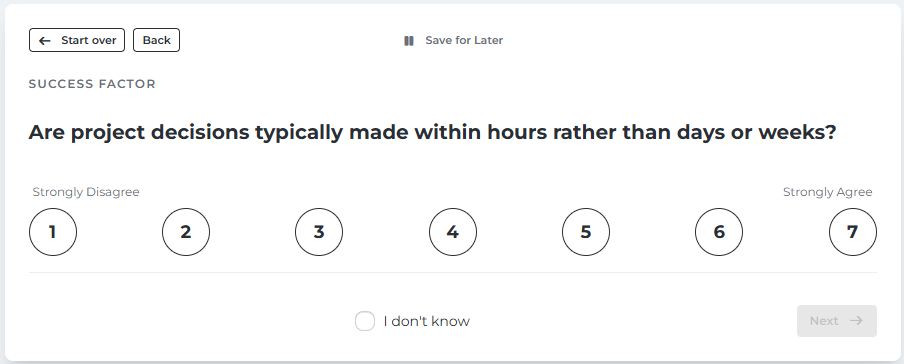
The diagnostic assesses outcome readiness alongside delivery controls. The shift is from “was the milestone hit?” to “is the organisation ready to realise value from what is being delivered?” That is the gap between compliance and assurance — and where your governance framework delivers the most strategic value.
20-Year Empirical Record
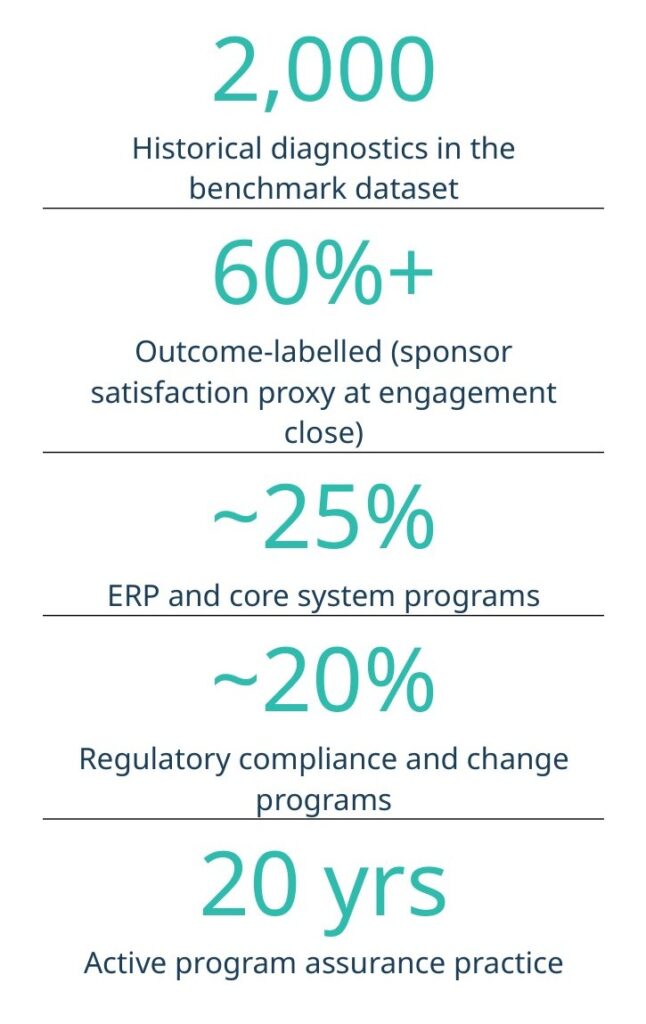
The benchmark dataset draws on 2,000+ diagnostics conducted over 20 years of program assurance practice, with roughly a quarter in ERP and core systems and a fifth in regulatory change. Outcome data from 1,200 programs is coded against whether sponsors judged the program delivered to expectations and achieved its intended business outcomes. Statistical regression is applied to calculate correlations and confidence levels. Where cohort matching is thin, confidence intervals are widened and disclosed.
Every condition and recommendation in the report comes from the Recommendations Library — not generic maturity-model criteria, but interventions grounded in what governance forums actually needed to see at the gate across comparable programs. The methodology is standardised and versioned. Multi-respondent attestation corroborates the evidence base across roles. Independence guardrails are published, scoring is robust and standardised, there are no contingent fees based on outcomes, and conflicts are disclosed. It is your documented due diligence.