
Business cases are optimised for approval, not accuracy. How do you know if the team is ready to deliver on their promises?
Get a view of the real risks of the project in time to prevent problems and approve funding with confidence.
Why financial controls don’t manage delivery risk
Stage-gate funding and milestone-based release control capital allocation across the project lifecycle. They do not control delivery risk or ensure those funds see results. Funding can be released on schedule while control failures accumulate beneath the surface — business readiness gaps, resourcing shortfalls, and stakeholder misalignment compounding behind milestone reporting that shows green.
You have applied investment-grade scrutiny at the initial business case approval. But during execution, the only signals available are internally-generated — produced by the team whose budget depends on continued funding. Traditional financial controls manage expenditure. They do not verify whether the program is set up to deliver the approved plan as promised.


Investment governance record at capital release
The Governance Decision Memo creates a documented record at the point of funding release:
- Recommended action: proceed, step-up discipline, or commission full assurance
- Confidence score with explicit basis
- Conditions-to-proceed with owner roles and acceptance criteria
- Benefits-at-risk assessment
The Memo provides evidence that an independent, benchmarked assessment was applied before funding was released. Whether the program succeeds or not, the record documents what was assessed, what was found, what conditions were set, and what the recommendation was. If full assurance is recommended, and optional Assurance Panel RFP pack can be provided with a tight but detailed scope, ensuring efficient delivery regardless of provider.
Portfolio comparability
Every program in the portfolio reports differently — narrative, RAG, earned value. The CFO cannot compare delivery confidence across programs when every project manager defines progress on different terms.
ProjectPhD applies one methodology with consistent outputs at every gate. A Portfolio Subscription provides a comparable delivery confidence metric across all material programs — heatmap, trend, and watchlist data the CFO can present to the board.
Benchmarked against outcome data
The benchmark is built on real data gathered over 20 years. Programs are matched to peer cohorts across multiple dimensions — sector, program type, size, stage, and complexity. The outcome data shows how comparable programs actually performed: what proportion delivered on time, and which control profiles correlated with successful delivery or project failure.
The confidence score discloses its basis explicitly — respondent coverage, alignment strength, attestation quality, and cohort match quality. It is a structured signal with a documented evidence trail, built on the same empirical standard you apply to any investment decision.

20-Year Empirical Record
Built on 20 years of data observing what programs said they would do, what they actually did, and what they did (or didn’t) deliver.
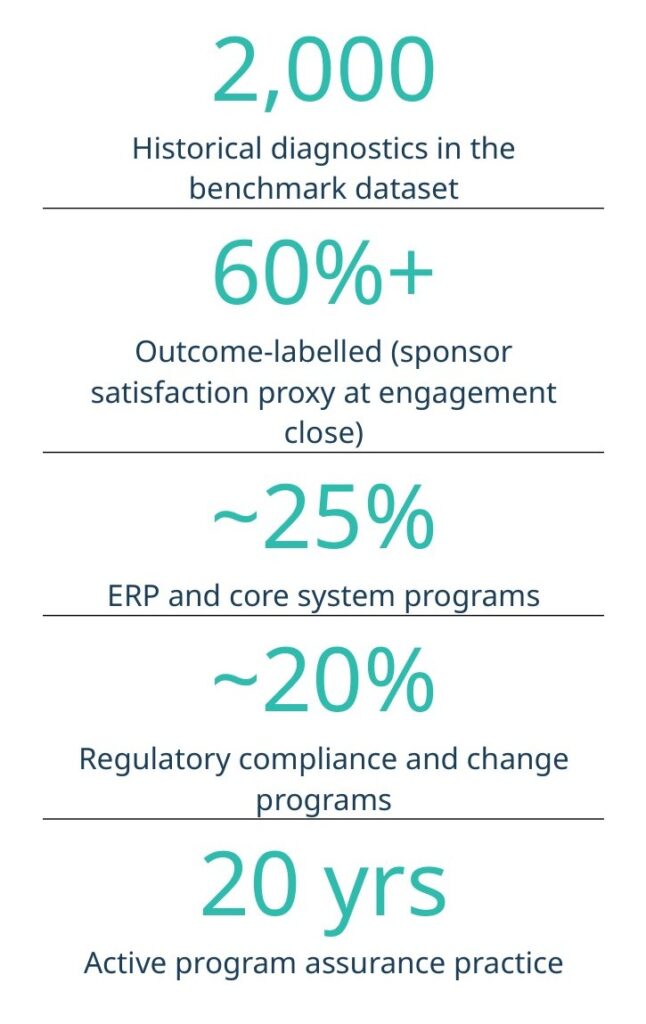
The benchmark dataset draws on 2,000+ diagnostics conducted over 20 years of program assurance practice — roughly a quarter in ERP and core systems, a fifth in regulatory change. Cohort matching operates across multiple axes so the comparison is against programs structurally similar to yours, not an undifferentiated average. Statistical regression is applied to calculate correlations and confidence levels. Where matching cohorts are thin, confidence intervals are widened and the limitation is disclosed. The methodology does not stretch beyond what the data supports.
Every recommended condition is drawn from the ProjectPhD Recommendations Library: not a generic maturity model, but interventions grounded in what boards and sponsors actually needed at the funding gate, and what happened in comparable programs where those conditions were absent. The methodology is standardised, versioned, and outputs are scored independently — there are no contingent fees, and all conflicts are disclosed. Multi-respondent attestation corroborates the evidence base across roles rather than relying on any single account. The Alignment Index surfaces where stakeholder views diverge, documenting disagreement as an investment signal rather than a political finding.