
You need this project to deliver, so it can fund the next one – but program reporting is filtered, and program failure is not.
Get independent assurance of project health and risk factors in time to prevent problems and make decisions with confidence.
Why current reporting falls short
RAG dashboards, steering committee updates, and one-on-one briefings all pass through the same structural filter. The people delivering the program are the people reporting on its health. Status reporting is subjective, non-comparable across programs, and subject to optimism bias that intensifies as information moves up the chain of command.
You may already recognise the pattern: confidence holds steady across several reporting cycles, then collapses in a single update. The underlying risks were present at the previous gate — they were not surfaced because internally generated reporting cannot be independent of the delivery it describes. Business readiness gaps, resourcing shortfalls, and stakeholder misalignment are particularly vulnerable to this filtering — visible to those closest to delivery, but rarely surviving the journey to a steering committee slide.
Increasing governance cadence does not resolve this. More frequent meetings with the same filtered inputs produce the same picture at higher volume. The structural issue is not reporting frequency — it is reporting independence.
What the Assurance Report delivers
The diagnostic assesses delivery risk across multiple dimensions — business readiness, sponsorship quality, resourcing, and vendor performance alongside technical execution. Multiple stakeholders contribute independently, and each attests their inputs.
The output is an Assurance Report that benchmarks your program against a matched peer cohort — programs of comparable size, industry, category, and complexity — drawn from over 2,000 historical diagnostics. The benchmark shows how programs like yours actually performed in comparable situations. It gives you a reference frame for your business case assumptions that does not depend on the people who wrote the business case.
Within 72 hours of engagement, the ordering executive receives:
- An assurance recommendation: proceed, where a step-up in discipline is required, or where a full assurance review is warranted.
- A risk rating: with confidence basis, benchmarked against outcome data from 2,000+ comparable programs
- An alignment index: highlighting where stakeholder views diverge, e.g. where the delivery team reports confidence and other stakeholders see exposure.
- Conditions-to-proceed: forward-looking, manageable delivery actions with named owners
- A 90-day action plan: identifying the highest-lift interventions
- A Governance Decision Memo: designed for board papers, when you are ready to circulate it
The benchmark shows how programs like yours actually performed. Where internally-generated status shows confidence but comparable programs with similar control profiles delivered late, over budget, or wrote off benefits – the tool provides a signal no steering committee can overlook.
You control the output
The Assurance Report is delivered eyes-only to you as the ordering Sponsor. You decide what circulates, to whom, and when. The Governance Decision Memo is formatted for board papers, but the decision to present it is yours.
Where stakeholder views diverge, the Alignment Index records the divergence as a documented signal — not as named attributions or individual performance findings. The output frames conditions to address, not faults to assign.
20-Year Empirical Record
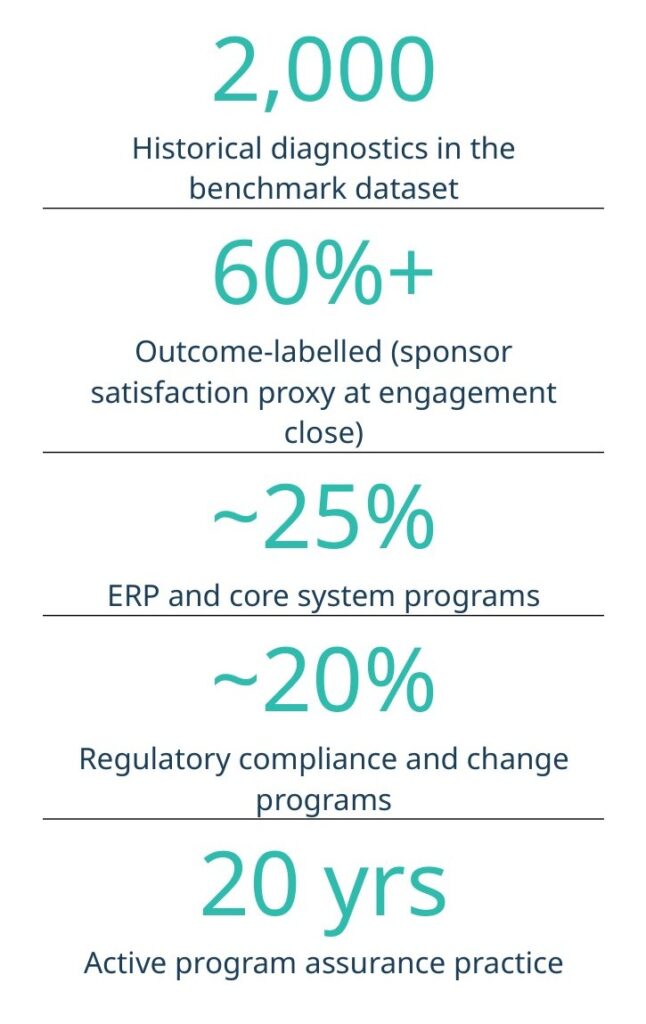
The benchmark dataset draws on 2,000+ diagnostics conducted over 20 years of program assurance practice, with roughly a quarter in ERP and core systems and a fifth in regulatory change. Outcome data from 1,200 programs is coded against whether sponsors judged the program delivered to expectations and achieved its intended business outcomes. Statistical regression is applied to calculate correlations and confidence levels. Where cohort matching is thin, confidence intervals are widened and disclosed.
Every recommendation is grounded in 20 years of seeing what boards and sponsors actually needed — and what happened when they didn’t get it.
Every condition and recommendation in the report comes from the Recommendations Library — not generic maturity-model criteria, but interventions grounded in what governance forums actually needed to see at the gate across comparable programs. The methodology is standardised and versioned. Multi-respondent attestation corroborates the evidence base across roles. Independence guardrails are published, scoring is robust and standardised, there are no contingent fees based on outcomes, and conflicts are disclosed. It is your documented due diligence.