
You need project assurance to make clear decisions on in-flight projects, not a 3-month post-mortem.
Get independent assurance of project health and risk factors in time to prevent problems and make decisions with confidence.
Why delivery reporting is not enough
Program status reports are generated by the team delivering the program. As reporting moves up the chain of command, optimism bias compounds. A schedule risk flagged at the working level becomes an amber rating at the project board and a green summary at the executive committee.
The result is what practitioners call watermelon reporting: programs that appear healthy on the outside while failing systemically on the inside. The Sponsor holds accountability but depends on filtered information. The board releases funding without an independent check. If the program fails and a post-mortem asks what governance was in place at the time, it will find a stack of self-assessed RAG dashboards.

What the Assurance Report delivers
Within 72 hours of engagement, the ordering executive receives:
- Risk rating with confidence basis — not a binary pass/fail, but a graded assessment with the evidence and assumptions behind it disclosed
- Benchmark percentile — the program scored against a matched peer cohort by sector, type, size, and stage, drawn from outcome data across 2,000+ diagnostics
- Alignment Index — where stakeholder views diverge across risk dimensions, documented as a governance signal rather than a performance finding
- Top 5 risk drivers — linked to attested respondent inputs, not consultant opinion
- 90-day action plan — highest-lift interventions with named owners, timeframes, and acceptance criteria
- Benefits-at-risk indicator — flags where delivery risk threatens committed benefits realisation
- Business readiness assessment — evaluates whether the organisation is prepared to adopt the outcome, not just whether deliverables are on track
- Governance Decision Memo — a single-page decision artefact with recommended action, confidence level, and conditions-to-proceed, designed to circulate independently in board papers
The output is not a retrospective. It is a forward-looking set of conditions-to-proceed, a 90-day action plan, and a Governance Decision Memo designed to sit alongside the business case at the point of capital release.
Built on evidence, not opinion
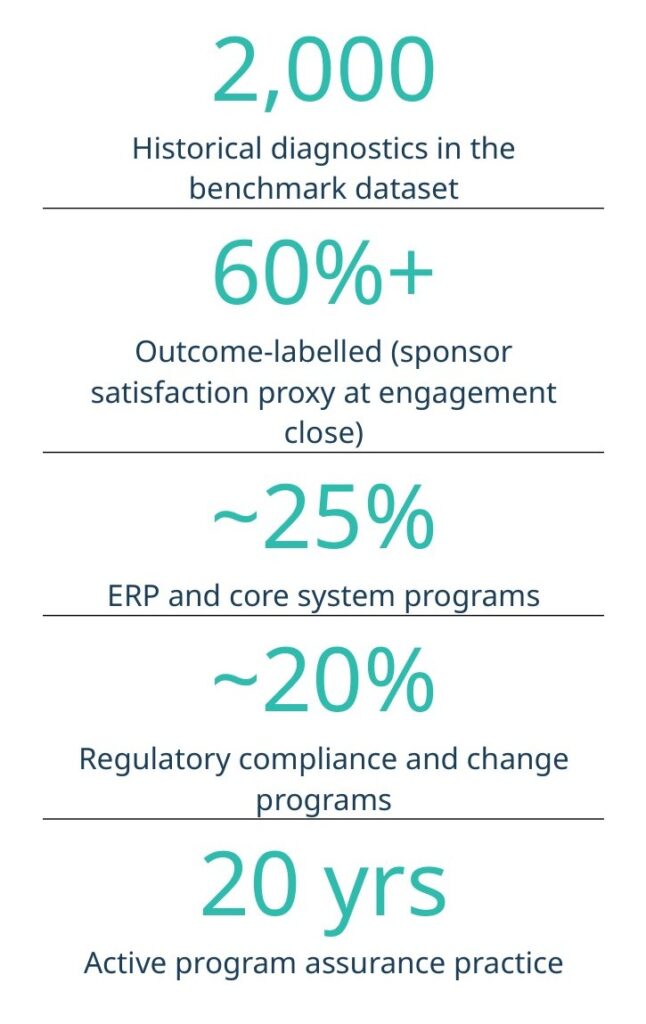
The benchmark is based on an empirical dataset: 2,000+ diagnostics conducted over 20 years of program assurance practice, and structured assessment of final project success outcomes.
Statistical regression assessment of each project, with cohort matching controls for sector, program type, size, and stage underpins every report. When the matched cohort is small, the report discloses this and explains the confidence impact. The Recommendations Library, the conditions-to-proceed and interventions recommended in the Assurance Report are drawn from this 20-year evidence base.
Every recommendation is grounded in 20 years of seeing what boards and sponsors actually needed — and what happened when they didn’t get it.
Who uses ProjectPhD
Program Sponsors — Forward-looking conditions-to-proceed, not a verdict on your program. Eyes-only default: you control the output.
Boards and Governance Committees — A defensible governance record at the point of funding release, designed to hold up under post-mortem scrutiny.
CFOs — Investment governance at the point of capital release, benchmarked against how comparable programs actually performed.
CIOs — An independent record of where delivery risk actually sits — across business readiness, resourcing, vendor, and technology execution.
PMO Leaders — Board-grade stage-gate outputs in 72 hours, with portfolio-level comparability across all material programs.
Internal Audit — An independent diagnostic embeddable in the audit plan as a recognised governance control, with a Panel-RFP Pack when panel rules apply.
Program Directors — An independent channel to put the risks you have been raising on the record, with benchmark data and conditions-to-proceed.